
Light Your Way to Better Sleep
Could artificial lighting be messing with your nightly repose?
One of the pervasive health issues of our time is the effect of poor sleep quality on our lives.
And one of the advantages our ancestors had in the sleep department was not having to fight the constant onslaught of light on our bodies at inopportune times. Let’s look at why this matters if you’re serious about your sleep.
The role of light
Prior to the Industrial Revolution (i.e., for most of human history), people woke up naturally rather than to the jarring sound of alarms. They followed the rhythm of their internal body clocks, which, as it turns out, is influenced by the sun.
When we spend time outside, as our ancestors did, the sunlight naturally awakens our bodies and brains. Conversely, as the sun goes down, melatonin increases and helps us feel tired, contributing to a good night’s rest. It’s not just about falling asleep more quickly but also getting a deeper and more restorative sleep, helping us maximize our functioning the next day and our overall health.
As humans over time dispersed from the tropics toward the poles, the sun’s de facto role in our sleep patterns started to wane. In Svalbard, Norway, the sun doesn’t set at all from around April to August, nor does it rise from around November to January. Imagine living in complete light or darkness for months at a time.
In modern times, the price of living in such areas is either acceptance that your sleep may be disrupted for parts of the year, or an increased reliance on technology, such as artificial lighting to simulate daylight, and blackout curtains to bring darkness.
Then you have people with chronic circadian sleep disorders who, no matter where they live, cannot resist the urge to sleep and wake at odd hours. Or people who wake at night simply because they have jobs, travel, or other circumstances that require it.
But those are somewhat exceptional examples. The rest of this post will assume you have (or aspire to have) a “normal” circadian sleep cycle, a “normal” (9-5) job, and live in an area that follows a “normal” day/night cycle, with abundant natural light and darkness throughout the year. (Svalbardians, adjust tactics accordingly.)
The point is that light, whether manmade or natural, has a significant effect on our sleep patterns, and we can use that to our advantage.
Light therapy
What does it mean in practical terms?
It’s about increasing the amount of light we are exposed to during the day and minimizing it starting 2-3 hours before bedtime. This includes all sources of light, from the sun to indoor lighting to device screens.
Getting outside for some sun is great, and doubly so if we can use that time to do something productive like exercising, tending to a garden, or socializing with a friend. Exercise itself is great for sleep since it tires you out physically.
The sun is our friend for other reasons too, like aiding vitamin D production, treating skin conditions, and alleviating depressive symptoms. Just don’t overdo it, because skin cancer and eye diseases from overexposure to UV light are also a thing and we don’t want to increase our risk.
Artificial lighting has been a great boon to society, but too much of it at the wrong time is wreaking havoc on our circadian rhythms (internal body clocks). The prime culprit is so-called blue light, which hinders melatonin production, waking us at a time when our bodies are trying to wind down for the night. Fortunately, there are ways to reduce blue light’s impact at the source:
- Use a calculator to determine how much light is required for your space. Buy the lowest wattage light bulb (or lowest luminosity light) that still provides adequate light.
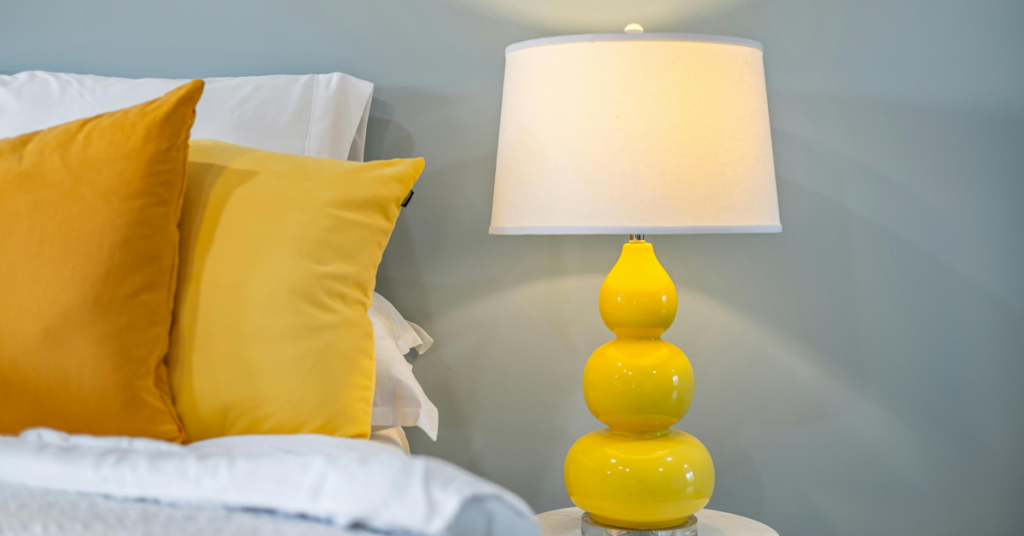
- For ambient lighting in living areas and bedrooms, prefer warm-colored light to cooler “cool white” or “daylight” bulbs, which emit more blue light. Cooler lighting is usually only needed as task lighting (for reading, food prep, makeup, shop work, etc.).
- For task lighting, prefer “cool white” bulbs to “daylight” bulbs. Daylight bulbs emit the bluest light and are usually only needed for very detail-oriented tasks where visibility and color rendition are crucial, such as when making art. That is to say, the average household rarely needs it. Daylight bulbs boost alertness the most, so from a sleep perspective they are best restricted to daytime use.
- Where possible, use dimmers to tailor light levels to your current activity. Watching TV requires less light than reading a book.
- Start reducing light levels as it gets closer to bedtime. If you don’t have dimmers, an alternative is to design your room with multiple lights that can be operated independently. For example, if your room only has bright ceiling lights, you might add a cozy low output table lamp and switch over to that as the evening progresses.
Light bulb color temperature approximates the sun at different times of day: Soft white for sunrise/sunset, cool white for morning/afternoon, and daylight for peak sun.
Aside from saving money on lighting, implementing these steps serves to bring your body in closer alignment with nature, making you feel sleepier sooner. Once your body starts giving you the signs–yawning, watery eyes, drowsiness–it’s crucial to drop everything and hit the sack as soon as possible.
Here’s why: If the day is winding down and you’re engrossed in a task, you might be tempted to delay your bedtime, thinking you’ll just sleep longer to make up for it. However, it doesn’t work that way. Sleep happens in distinct phases that won’t wait for you–once you’ve missed a phase, your sleep won’t feel as restorative as it could have been, even if you sleep in to try to compensate.
Conversely, you’ll find that going to bed on time enables you to wake up not only earlier, but more refreshed and ready to efficiently take on whatever task you dropped the night before. Quality sleep ensures you’ll work faster and with fewer mistakes, ultimately saving you more time than whatever may have been “lost” to sleep.
Blue light tech
Of course, the sun also emits blue light, and at levels much higher than artificial sources. So why is that usually not a problem? Well, the sun has a built-in limiter since it “turns off” at the end of the day. So our ancestors were automatically protected in that regard.
In the modern world, we are responsible for our own blue light mitigation. While artificial lighting is the main source of blue light exposure after sundown, other culprits include our computers, TVs, and other devices.
Turning the brightness down on your devices helps if they don’t do it automatically. Modern devices also often have blue light filtering features, such as Night ShiftTM on iPhones. Note however, that these tactics, while helpful, do not eliminate blue light but only reduce it.
Granted, the blue light emitted by our devices is comparatively low and, according to some experts, not enough to fret over. Even if that’s true, mitigation is not hard, and scientific consensus points to a measurable effect. If you take your sleep seriously and prefer to err on the side of caution, it still makes sense to take action.
Given these issues, and the fact that devices are disturbing our sleep in other ways, it would seem the best solution is to turn them off completely or at least spend less time on them in the hours before bedtime.
Going amber
But easier said than done, right? Turning off our devices just isn’t practical for many of us in the modern age. And even if it was, you still have room lighting to worry about, which, as mentioned, is the bigger concern compared to the dim light emitted by device screens. Enter blue light blocking glasses, which are designed to eliminate or greatly reduce blue light.
The solution to artificial blue light at night, short of shunning modern technology, is to use artificial blue light blockers.
Simply throw on a pair in the early evening while continuing to use your lights and devices to reduce their impact on your sleep. For maximum effect, you’ll want the ones that block the full spectrum of blue light, which can be identified from their characteristic amber-tinted lenses. If you wear prescription glasses, amber clip-on lenses are also available.
Unsurprisingly, donning amber-colored lenses will make everything look…amber. This will bother some people more than others. It’s less of an issue if you’re reading or washing the dishes, but it might be annoying if you’re watching TV and everyone’s face is orange.
If you’re on the fence, the glasses are cheap enough that it won’t break the bank if you decide to give them a try. If you’re forgetful like me, once you have them you can set a recurring reminder on your phone to put them on after dinner so you don’t have to think about it every night.
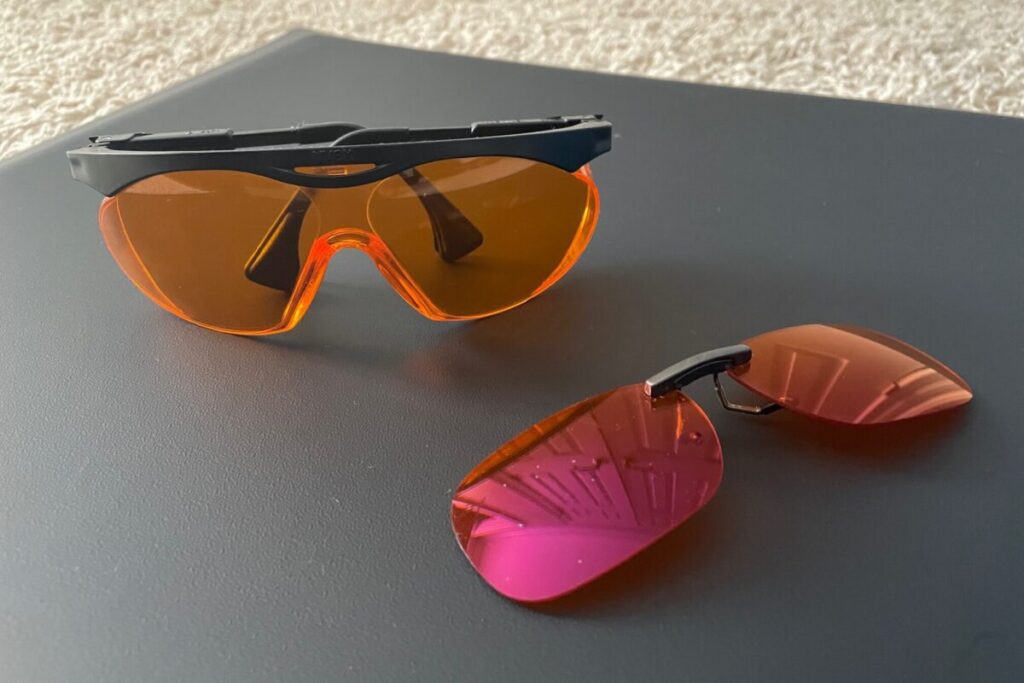
Consider skipping the blue light coating when buying prescription glasses for daytime use. The coating does not change the lens color, so it still allows some blue light through. Also, we generally don’t want to be blocking blue light all the time, only starting close to bedtime. Your body needs blue light during the day for regulating sleep-wake cycles, and blocking it then would be counterproductive.
However, some people wear blue light blockers hoping to relieve symptoms like eye strain and dry eye. While their effectiveness for this purpose is debated, if they seem to relieve your symptoms and you wear them during the day, you should weigh that against their impact on melatonin production and the possible sleep issues that would ensue.
Or consider the middle ground, which would be to wear yellow or clear blue-light blocking lenses since they don’t block as much of the blue light but might still help with eye symptoms.
Remember that overall, the key to light management is twofold: suppress melatonin during active hours (via light exposure) and promote it around bedtime (via light blocking).
Beyond room lighting
When you are ready to turn in, ensure all lights are off as even dim light exposure can disrupt rest. If nightlights are needed for safety, those are available in amber too.
Consider turning off any outdoor lighting that you control, especially if it shines through the bedroom window. Not only does it disrupt sleep, it can also attract moths and bugs into the house and confuse wildlife. For example, it can trick birds into flying into windows, which usually ends up killing them.
Outdoor artificial lighting can also harm pollinator abundance and diversity since some bugs and animals that are important to the ecosystem only pollinate at night. And it’s actually contributing to the impending extinction of some species, such as fireflies.
That said, some people like to sleep with exterior lights on for the perceived safety. You can get the best of both worlds by installing a motion sensor so the light is on when you need it and off when you don’t. If you must have outdoor lights on all night, those can be had in amber also.
What about incoming light that you can’t do anything about? Blackout curtains and eye masks are great if you can’t stop the light coming into your house at the source–especially helpful in neighborhoods with streetlights.
Conclusion
The Industrial Revolution brought with it technological progress, but also more indoor work and increasingly rigid work schedules that are out of sync with the rhythm of the sun, undermining our light-based biological sleep mechanisms that for most of history helped us get a good night’s sleep.
While the bedrock of quality sleep is a healthy lifestyle, consistent sleep schedule, and a comfortable sleeping environment, we can take it to the next level by understanding the role that natural and artificial light play on our circadian rhythms and adjusting our environments accordingly.
Some of the steps available to us right now include getting adequate light exposure during the day, reducing that exposure as the day winds down, and eliminating it altogether at bedtime. Low-cost tools and methods around light control make it easier to continue our modern way of life with less sleep disruption.